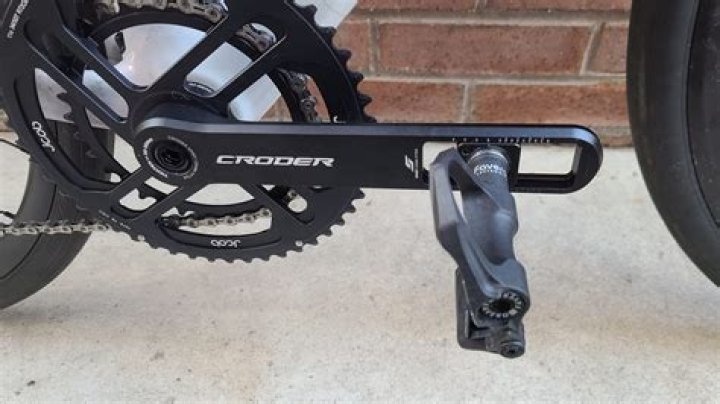
Going to a shorter crank will allow you to ride at a lower back angle which minimizes frontal surface area improving aerodynamics. It can be frustrating to know that there are many available crank options that would work for an athlete.
Are shorter crank arms better?
Therefore, shorter crank lengths are recommended for stand-up bicycles to avoid fatigue." Shorter cranks are common in downhill for a reason. The main takeaway from the published science is that crank length either doesn't affect pedalling performance, or there's a possible advantage to shorter cranks.
Do I need shorter cranks?
“If you struggle with knee or back problems on the bike, shorter cranks might help”, says Burt. “Not because they directly fix the problem, but because shorter cranks put less load on your joints and hip flexors.”
Are shorter cranks better for climbing?
2. Shorter cranks are easier to spin and thus better for acceleration and quickness, relative to something longer. Tradition always dictated that track riders used shorter cranks, as their riding style required those characteristics.
Are short cranks harder to pedal?
It changes gearing
So if you do end up changing crankarm lengths, it will change your gearing as well. The relative jumps between gears stay the same, but the overall range will feel slightly easier to pedal, or smaller, with shorter cranks and harder with longer ones.
35 related questions foundWill shorter cranks help my knees?
Pain is relieved. Just by installing shorter crank arms, without any other adjustment, the knee at maximum flexion is lowered by 7.5 mm. That difference provides approximately 3° to 4° of relief.
Does crank arm length really matter?
'As far as maximal sprint power and metabolic cost are concerned, crank length can be anywhere from 145mm to 195mm and it really doesn't matter. 'A longer crank is basically a lower gear ratio. It might allow you to climb better, but its effect is tiny compared to shifting up two sprockets on your cassette.
Are shorter cranks better for hips?
Less Hip Flexor Strain Means a Better Run.
A shorter crank means that you don't have to lift your thigh as high with each revolution, meaning that your precious hip flexors will be fresher when you start the run.
Are shorter cranks better MTB?
Macdermid found that riders reached their peak power nearly 1 second quicker on 170mm cranks than they did on 175mm cranks. That means shorter cranks give riders better acceleration, which can make a difference when passing other riders or trying to clean an obstacle.
What crank length do the pros use?
Over the years, guidelines for crank length have been generally accepted. Riders with crotch-to-floor measurements of less than 30 inches (76 cm) are usually sold 165- or 170-mm cranks, riders who measure 30-33 inches (76-84 cm) are guided toward 172.5-mm cranks, and taller riders end up on 175s.
Are longer cranks better for climbing?
If you're having problems with your lowest gear, stick with longer cranks. They reduce force at the same gear ratio. Shorter cranks allow you to use a lower gear at the same foot speed... but if you don't have a lower gear, you're stuck.
Do lighter cranks make a difference?
Once you get all your components "spinning" and is constant; it doesn't really matter if they are lighter or not. It's only when they are confronted by gravity or opposing forces when it will make a slight difference again.
Are 160mm cranks too short?
5 Answers. Show activity on this post. 160mm crank is abnormally short. This doesn't mean that you shouldn't but as Axemasta mentions, you should have a bike fit before deciding what crank arm length you should have.
Does 2.5 mm crank length make a difference?
Most experienced cyclists would consider a 5 or 10 mm difference in saddle height measured to the bottom of the pedal stroke to be a significant change, so they should not dismiss a 2.5 or 5 mm difference in crank length as being any less important because that makes a 5 or 10 mm difference in the saddle height when ...
What are the disadvantages of cranks?
Disadvantages of crankshaft:
- Failure of bearings may occur.
- The total cost of manufacturing is high.
- Friction is increased which results in the heating of the crankshaft.
Why do MTB have longer cranks?
Back in the day it was thought that longer crank was better, because they increase the pedalling leverage, thus enabling you to create more power. However, several studies have shown that even dramatic crank length differences have only a small effect on how much power you can produce.
What crank arm length should I use for MTB?
Trail/Enduro - 170mm crank arm length is the most commonly used size and is recommended to keep a good leverage ratio and have a bit more ground clearance due to having more travel.
Does crank length affect gearing?
Many folks are unaware that your bike's crank length has a significant effect on its overall gearing.
What crank length is recommended for your inside leg measurement?
Normally fit adult riders should use cranks which measure about 20% of their effective leg length, rounded to the nearest 5mm, whereas growing children can safely increase this figure to 22%. This length goes all the way to your hip joint and cannot be measured directly.
How does crank length affect power?
Namely, the general view is that shorter cranks allow you to spin and accelerate quicker but at the cost of high torque or power. Theoretically, this is a boon to sprinters and crit riders. In contrast, longer cranks take more time to turn over and force a lower pedaling rate, but are able to produce higher torques.
How long should my bike cranks be?
The crank length represents the distance between the centre of the bottom bracket and the centre of the pedal axis. The most common lengths are 170, 172.5 and 175 mm, but it is possible to find cranks between 165 and 180 mm in the market.
Does bike crank length matter?
Crank length can be used as a tool to improve fit related issues impacting comfort, power, and aerodynamics. Moving to a shorter crank can improve: Comfort: A shorter crank length reduces range of motion at the knee (extension and flexion), hips, and low back.
What is the difference between 165mm and 170mm crank?
165mm's make you spin faster, but with less power because of reduced leverage, 170mm's slower but more power. This is mostly effective in road racing. But for DH racing/riding where higher cadence isn't crucial, it mostly comes down to what feels nice for you, and what will give you the most ground clearance.
How do I know what crankset I need?
Cranks come in a range of sizes, most commonly from 165mm to 190mm, and ideal crank length is often determined by three factors: your height, your cycling discipline and your personal preferences. If you change your crank length, it will change how it feels to pedal your bike, and it may change your fit on your bike.