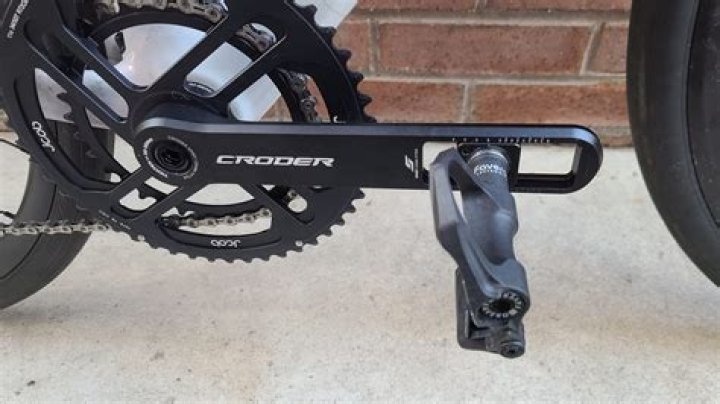
Compact chainset
What does a 34 50 crankset mean?
Standard Setup
Currently, the most common gearing setup on new road bikes is a 50/34 chainset with an 11-28 cassette. This means that the big and small chainring have 50 and 34 teeth, respectively, and the cassette's smallest cog has 11 teeth and its largest cog has 28 teeth.
What is the difference between 50 34 and 52 36?
52 36 is faster on flat terrains. The 52T chainring when combined with small cogs like 11, will give you more speed than using a 50 34. 3. The 50 34 compact crankset is lighter than 52 36 because it comes with smaller chainrings, shorter chains, and can also be paired with smaller cassettes.
What do the numbers on cranksets mean?
The numbers (53/39, etc) refer to the number of gear teeth on each end. In the case of the crank, it means that your large chainring (the "gear" attached to the crank) has 53 teeth, and the smaller one has 39.
How do I know what size crankset to buy?
Crank length is measured from the centre of the bottom bracket axle to the centre of the pedal axle. If you're not sure what length the cranks on your bike are, the quickest way of finding out is typically to just look at the backside of your cranks, just below the pedal axle.
33 related questions foundWill any crankset fit on my bike?
Not all cranksets are compatible with modern road bike's bottom bracket shells. Actually, compatibility depends on brand and model. Cranksets attach to the bottom bracket, and there are different types of bottom brackets in the market. In addition, most chainrings can't work across bike brands and models.
Will shorter cranks help my knees?
Pain is relieved. Just by installing shorter crank arms, without any other adjustment, the knee at maximum flexion is lowered by 7.5 mm. That difference provides approximately 3° to 4° of relief.
What gear should I use on a flat road?
High Gear. This one is great for descending, accelerating, or for use when you want to go nice and fast on a flat road. In a high gear, you travel a long way for each turn of the pedal.
What is the difference between a compact crankset and standard?
A compact crank refers to a road bike crankset with relatively smaller chainrings that can make pedaling easier. While 'standard' cranks come with a 53-tooth large chainring and a 39-tooth small ring, compact cranks usually feature 50- and 34-tooth rings.
How do I know what size my bike cassette is?
A cassette may therefore be sized as 11-32t. The first number refers to the number of teeth on the smallest sprocket (the highest gear, for fast pedalling at speed) and the second number to the biggest sprocket (the lowest gear, for climbing hills).
Can I use 52 34 chainrings?
Of course, you can use 52/34 chainrings if it suits your needs and purposes. It runs well and serves a lot of benefits but has downsides too. Your compact and semi-compact cranksets can be modified to give you this combination.
What is an 11 32 cassette?
The notation you've noticed simply means that for one of these cassettes, the smallest sprocket has 11 teeth, the largest has 32 teeth. And the second cassette has smallest sprocket 12 teeth, largest sprocket 25 teeth. So these numbers are basically the "range" of gears covered by a cassette.
What is a 53/39 crankset?
Standard cranks have 53/39 gearing, meaning they have a 39-tooth small ring and a 53-tooth big ring. Ring is short for chainring, which is what the front gears are called that are bolted to the cranks. The bolt circle diameter (BCD) of standard cranksets is 130mm.
What gear ratio is best for climbing?
Based on your anticipated speed and minimum tolerable cadence, are the gear ratios on your bike sufficient? A common setup on a road bike adapted for climbing is a compact road crankset with 50-34 chainrings and an 11-32 cassette, which gives a lowest gear of 34:32 or a ratio of 1.06:1.
What cassette is best for climbing?
For hill climbing and mountainous terrain, we recommend a road cassette such as the 11-32T SRAM Red 22 XG1190 11 Speed Cassette (A2), or the 11-34T Shimano Ultegra R8000 11 Speed Cassette.
How many gears should a road bike have?
A road bike will have either a triple, double or compact crankset. This refers to the number and size of chainrings (located by the pedals). A triple crankset has 3 chainrings; it is often paired with a 9-speed cassette on the rear wheel to give it a total of 27 gears.
Do PROs use compact crankset?
Compacts are definitely used by PROs, but only on really steep stages. The opposite end of the spectrum, PROs will often ride 53-42s (or some variation, sometimes 44, sometimes 40) for the classics.
What is the advantage of a compact crankset?
Related to the previous point, a compact allows you to tackle more terrain in your big chainring meaning less front shifting. This produces less wear on the chainrings, chain and front derailleur.
Does crankset make a difference?
Absolutely! The main purpose of upgrading your crankset is for performance improvement and that means adjusting or replacing the crankset to get an improved experience. So yes, the crankset is always worth upgrading.
Should you change gears while pedaling?
Shifting your gears while standing still stretches the cables and strains the derailleurs. Remember, you have to be pedaling before the bike will change gears.
Which gear is fastest on a bike?
High Gear = Hard = Good for Descending: The “highest” gear on your bike is the largest chain ring in the front and the smallest cog on your cassette (rear gears). In this position, the pedaling will be the hardest and you'll be able to accelerate while traveling downhill.
What does crossing the chain mean?
Cross-chaining is when you're in your big chainring and the biggest cog on your back cassette, or on your small chainring and your smallest cog. The problem is that this stretches your chain diagonally to its limits, and needlessly so, since you could just shift to your other chainring and find a similar gear ratio.
Are shorter cranks better for hips?
Less Hip Flexor Strain Means a Better Run.
A shorter crank means that you don't have to lift your thigh as high with each revolution, meaning that your precious hip flexors will be fresher when you start the run.
What is the difference between 170mm and 175mm cranks?
Macdermid found that riders reached their peak power nearly 1 second quicker on 170mm cranks than they did on 175mm cranks. That means shorter cranks give riders better acceleration, which can make a difference when passing other riders or trying to clean an obstacle.
Are longer crank arms better for climbing?
There is no rock-solid formula for determining crank length, saddle height, top tube length, or any of those things. There are general rules of thumb, but there are a lot of different confounding factors such as your preference for climbing making it possibly more beneficial to err on the side of a longer crank.