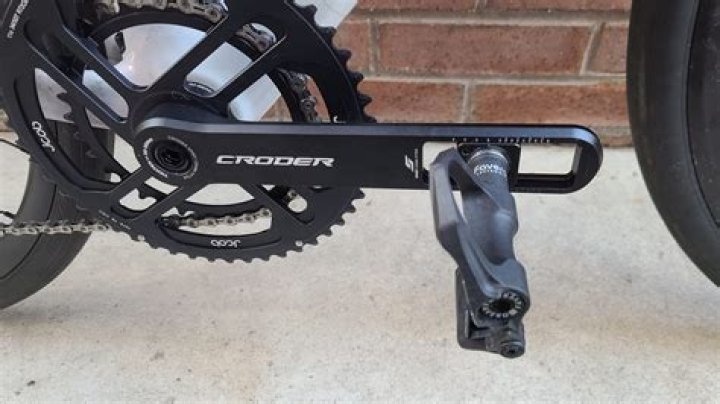
The length of a pedal spanner is for removing badly installed, dry or corroded, pedals, NOT for doing up properly greased ones. 7. The right hand (drive-side) pedal tightens up by turning the axle clock-wise, so follow the same method, but turn the axle clockwise (or the crank anti-clockwise).
How do you use a pedal spanner?
Turn pedal wrench counter-clockwise to remove right pedal or turn crank so the pedal is pedaling forward. Use care not to abrade skin. Continue to turn wrench counter-clockwise and remove pedal completely from crank. Rotate bike as necessary until left pedal is easily accessed.
What is a pedal wrench used for?
Use a pedal wrench or hex key to unscrew the pedals from the crank arms. Right pedals loosen by turning counter-clockwise, left pedals loosen clockwise. Apply bike grease to the new pedals and screw them in at an even 90 degree angle.
Can you use a regular wrench instead of a pedal wrench?
Normal 15 mm wrench works for all mine
You don't need a special pedal wrench. But no, you likely won't find a suitable one at the hardware store. The flats on most pedals are thinner than the width of common 15mm open end wrenches. If you find one that's real thin, it may work.
How do you remove pedals without a pedal wrench?
How to Take off Bike Pedals without a Pedal Wrench
- Step 1: Position the Bike Accordingly. ...
- Step 2: Insert the Spanner Where It is to Belong. ...
- Step 3: Rotate the Spanner in the Anti-clockwise Direction. ...
- Step 4: Free the Pedal. ...
- Step 5: Turn the Bicycle around 180 Degrees. ...
- Step 6: Rotate the Crank Arm.
Is a pedal wrench necessary?
All modern pedals will screw into the crank arm using either one of two tools. Most pedals (like our reliable Thump flat pedals) require a pedal wrench, which is a long, thin tool specifically designed to fit the external spindle flats between the pedal and the crank leg (fig.
Are bicycle pedal threads universal?
To simply answer: No, bike pedals are not universal. Not only visually or for their different purposes for various cycling disciplines, but also internally. Bicycle pedals mainly have two sizes: 9/16” and ½”. The 9/16” is the more standard version of pedals and covers almost all subtypes.
Can I use a normal spanner on bike pedals?
Yes, it depends. The standard adjustable is probably too thick, but a basic slim spanner will work ok. Also, some pedals have Allen key fittings inboard so that can be a dodge too - though if the pedal is tight, you'd need a long key.
Do you need a torque wrench to install pedals?
Yeah, pedals should be tighter than just "hand tight" and you don't need a torque wrench.
What is a spanner?
A wrench or spanner is a tool used to provide grip and mechanical advantage in applying torque to turn objects—usually rotary fasteners, such as nuts and bolts—or keep them from turning.
Which side of the bike is left?
The right-hand side or driveside of the bike is the side with the gears on it. The left-hand side or non-driveside of the bike is the side without the gears.
Do you need to grease bike pedals?
It's necessary to grease pedal threads to prevent corrosion and facilitate installation. If the pedal threads aren't greased, the pedals will fuse with the crank arms, making removal a difficult task. You can use anti-seize compounds too because the involved parts aren't in dynamic motion.
Is it easy to change bike pedals?
Fortunately, you can easily replace your bike pedals at home using a few simple tools. When you replace your bike pedals, take the time to install the new pedals correctly so you don't have a hard time taking them off in the future.
How do you change pedals on a spanner?
Steps to remove pedals
- Face the drive side of the bike. ...
- Place spanner on the flattened surface between the pedal body and the crank arm.
- Holding the brakes with your hands. ...
- Once the pedal has been loosened, continue to rotate the tool anti-clockwise to free the pedal. ...
- Turn the bicycle around.
What can I use instead of a pedal wrench?
Since you don't have a pedal wrench, typically, your standard 15 mm open-end wrench will do the trick just as easily.
What tools do I need to change bike pedals?
Tools needed
Depending what pedals you use, you'll either need a 15mm open-ended wrench (pedal spanner), a 6mm Allen key, or an 8mm Allen key. Whatever the required tool, a long-handled version of it will mean extra leverage for extra security and easier removal.
What size is a bike pedal wrench?
Pedal wrench flats are typically 15mm in size. 9/16" (~14.3mm) is somewhat common on older pedals. 17mm and other sizes have been used, but you aren't very likely to encounter them.
What are 9/16 pedals?
The 9/16” is the most common pedal thread size on the market today and is the size that most manufacturers use for their pedals. Almost all modern adult bikes have the 9/16” pedal with 20 threads per inch (tpi).
What is bike Grease?
Grease is a heavier, waterproof lubrication which is generally used in places on the bike you don't take apart or see too often. It has two key, but quite different functions: To keep key components moving and free from water entering. To help places of static metal to metal connection from seizing up.
How do you measure bike pedal threads?
Check the Cranks on the Bike
Manufacturers made it easy to put the sizing on the crank, knowing that people would look for their pedal size. If your cranks are made up of three separate sections, two separate crank arms, and the spindle that goes through the frame, your pedals will be size 9/16″ x 20 TPI.
What are clipless pedals?
What are Clipless Pedals? Clipless pedals are actually a system comprised of special pedals and cleats, devices included with the pedals that attach to the soles of clipless cycling shoes. This means that you'll need to select pedals and shoes in order to upgrade to a clipless system.
Do all road bike shoes fit all pedals?
Some shoes are compatible with both two bolt and three-bolt pedal systems, but many, including more specialist performance shoes, are only compatible with one or the other. Look carefully at the product description on the cycling shoes product page to ensure your pedals and cleats are compatible with your shoes.